Review: The Wizard of Oz: Beyond the Yellow Brick Road
Posted by Snarkasaur on October 26th, 2009
One of the staples of my childhood and growing up was watching The Wizard of Oz on television every year. It always arrived at the same time, it never changed (this was before any digital touch-up work had been done to it), and it always ended happily. I’ll be honest, I probably haven’t watched it again since I was a child. The cheerful tones and dream sequence ending of it all would only awaken a bitterness for that loss of childhood that in many ways it represents. However, I know the story as though I’d seen it yesterday, and so when I put The Wizard of Oz: Beyond the Yellow Brick Road into my DS, I found the world I knew vastly changed. The story had warped, become interactive, and it awakened in me both a nostalgia that I hadn’t realized I’d feel, and a warm feeling at the way in which Media Vision transformed the tale into a genre I hadn’t quite expected.
The first thing I should mention in this review is that Wizard of Oz, surprisingly, is a dungeon-crawler. The dungeons are flowery meadows and charming beachside villas, but they’re dungeons nonetheless. In fact, much of the gameplay and style reminded me strongly of Etrian Odyssey and its ilk. There is a central hub for buying and selling. Players traverse dungeons with multiple floors, fighting monsters and looking for treasure. There’s even a party of four characters who level up, gaining stat points. The game is also surprisingly difficult, though the curve isn’t as severe as in other games of this style, and the difficulty is mainly in the boss fights (which aren’t numerous).
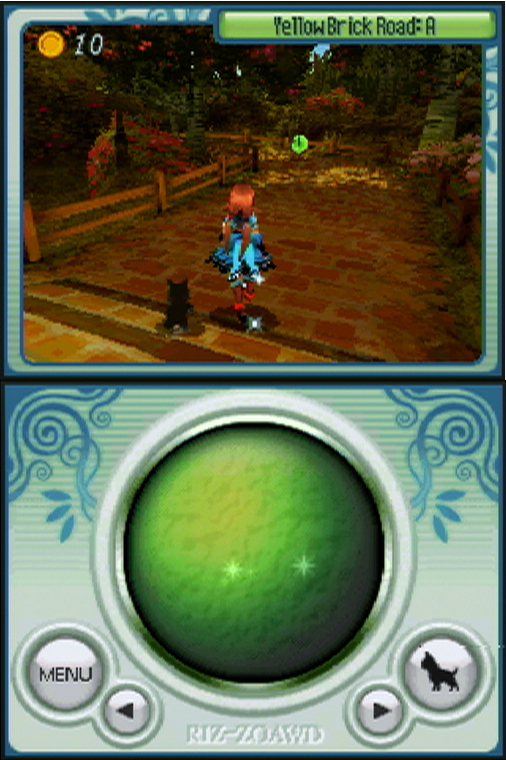
Where Wizard of Oz differs is in its approach to several basics of gameplay that I found odd. For one, movement is dictated by a track ball on the bottom screen of the DS that the player spins with the stylus. It’s a very strange way of controlling a character, who is Dorothy in this case. The track ball causes her to run in whatever direction the stylus has it spinning, and a stronger spin can have her running faster and faster, to a point. At first, I found this slightly difficult to control, but after a few days playing have actually grown accustomed to the precision that it allows, and while I may not endorse it over the simpler D-pad method of controlling a character, I also can’t really condemn it. It works. Given that everything in the game is controlled via the touchscreen, maybe it was the only way of granting movement at all. And that’s another point, never, not once, have I used a button on the DS to mimic any action or control anything. It’s entirely touch-screen based. I’m not sure the decisions around this either. It works. Everything is quite fluid. It’s just odd. Most games at least give you an option to use the buttons if you like.
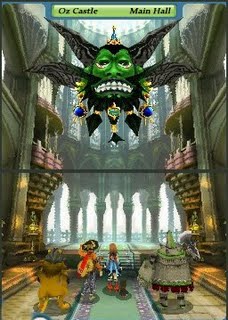
The story veers quite wildly from the original tale of Oz. For one, though the title bears the Yellow Brick Road, Dorothy and pals spend very little time upon that particular path. In fact, it is only during the intro and gathering of your companions, the staple Lion, Scarecrow (or Strawman as he is known here), and Tin Man, that you find yourself upon the gilded path, and then again at the end. The rest of the adventure happens after meeting Oz and undertaking his mission to steal magical eggs from the various witches of the land. He claims the witches to be malicious, but it doesn’t take too long to realize that something fishy is happening in the Emerald Kingdom. Nevertheless, players are never allowed to call out shenanigans in these situations, even when they smell the stench all over, so out into the land of Oz must one venture into dungeons unknown, looking for witchy eggs to steal.
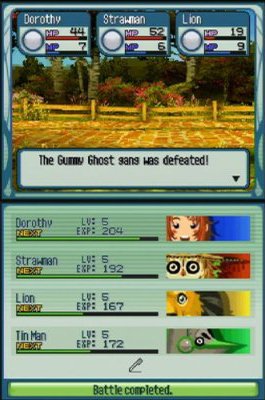
The dungeons themselves are simple affairs. Dorothy walks down often colorful roads with occassional branches to one side or another. There are treasure boxes to find, alternate paths to explore, and switches to switch. The enemies themselves are visible and even avoidable with some deft maneuvering of the track ball (something I found myself doing quite often, which also results in bad leveling). Combat is also quite simple, though with a touch of strategy not found in any game I’ve ever played. There are rounds for each battles, and each round consists of four actions. With the four characters available to a player, there are combinations of actions one can make in that round. Dorothy and Strawman have a ratio of 1:1. They can each make 4 actions a round by themselves if they wish, or 2 each. The Lion has a ratio of 2:1, and Tin Man has a whopping 3:1. This sounds confusing, but it actually works. Each round, players can mix and match characters to form up to 4 actions. This can mean 1 action with Tin Man and 1 with Strawman, 4 with Dorothy, or 2 with Lion, etc. Players can also dictate what actions each will perform and which enemy or player that character will attack/support.
Each character also has an affinity versus one of four types of creature. There are five types total. There are plant type monsters, shell type monsters, fish type monsters, and ghosts type monsters. There is also a fifth, neutral type that generally consists of humanoids or animals. The mixing and matching of characters for each round can often be determind by what affinity the player is facing. It’s an odd system, but also compelling at times and with a little practice I found myself whizzing through battles and in complete understanding of the dynamics involved.
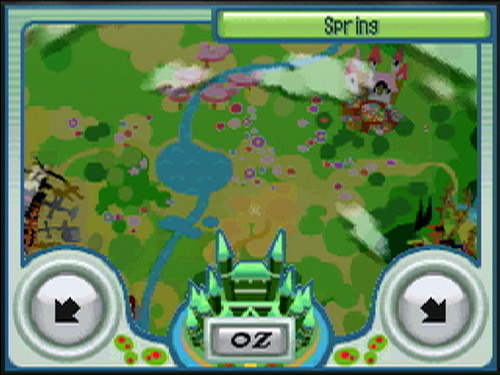
Now for the bad things. Many players will find the track ball system of movement completely unnecessary and give up on it before its nuances become apparent. There is also no map system for the dungeons, which has been one of the most frustrating things for me. There are roadsigns that to mark up to indicate what’s down a certain path, but the lack of a true map is puzzling. Most of these style of games have maps, either the kind players can draw themselves as in Etrian Odyssey, or that just draw themselves as the party progresses. Obviously, as in the olden days of gaming, players are free to whip out pencil and paper and draw their own maps, but that’s tedious and shouldn’t be necessary. The skill system is also odd and completely uncustomizable (as is most everything). Skills are learned from these dragon masters who can be found in the dungeons at specific spots. Players have to fight them and beat them in order to learn new skills. This is an interesting way to gain new abilities as it is pretty level and gear dependent, but in most games it is level anyway that determines skill gains. And it actually adds to the depth of the game in a way. However, many players will just find it tedious having to go find and fight these dragon masters every time they want a skill. This is something I can sympathize with.
Once beat, the dragon master just gives each of the characters a new skill without any choice or say in the matter on the player’s part. Many of the skills are for the most part worthless. The Lion’s ability to run away at 100% accuracy is something I’ve only ever used once. The story is something many people will find a difficult pill to swallow. There is such a pre-conceived image of The Wizard of Oz that any variation might be met with scorn. Once I’d thrown away those pre-conceived notions and just taken the idea of The Wizard of Oz as a backdrop for this game, I actually found myself enjoying it immensely.
The game certainly isn’t perfect, but it’s also very worth playing. Why they chose Oz as the setting is puzzling when it could probably have been done better with an entirely new story. Nevertheless, for players interested in this style of game, The Wizard of Oz: Beyond the Yellow Brick Road is an enjoyable experience if one’s in the right mood
|
| Doin It RIGHT: - Pretty settings and attractive style. - Addicting dungeon crawling gameplay. - Twisty-turny fairy tale story with a great ending |
Doin It RONG: - Combat gets repetitively boring. - No customization beyond armor/weapon choice, and very little even there. - Odd disparity in difficulty between normal fights and bosses. |
 FINAL SCORE: 6.5 / 10  |
|
![[Post to Twitter]](../wp-content/plugins/tweet-this/icons/tt-twitter-micro3.png)
![[Post to Digg]](../wp-content/plugins/tweet-this/icons/tt-digg-micro3.png)
![[Post to Reddit]](../wp-content/plugins/tweet-this/icons/tt-reddit-micro3.png)
![[Post to StumbleUpon]](../wp-content/plugins/tweet-this/icons/tt-su-micro3.png)
Tags: dorothy, DS, k-tuck writes awesomely long tags and i just want to emulate him, Review, wizard of oz, xseed
 Loading ...