


 Loading ...
Review: Castlevania: Lords of Shadow

When Castlevania: Lords of Shadow was announced, fans didn’t know what to expect. The newest in a long line of titles was touted as a reboot for the series, and seemed to draw heavily from God of War, Prince of Persia, and even Shadow of the Colossus. Is this a true sequel to the fantastic Castlevania games of old? Did MercurySteam and Kojima Productions do the series justice?
In Castlevania: Lords of Shadow, players are thrust into a world of turmoil. Terror has taken hold of the land. Monsters and demons have been spotted in increasing numbers, wreaking havoc on the landscape, capturing and killing people at will. Whispers of horrors once thought to be myths have been spreading, and the populace is gripped by fear. With nowhere else to turn, the people have put their faith into the Brotherhood of Light.
Players assume the role of Gabriel Belmont, a Knight of the Brotherhood of Light. Gabriel, like his brethren, is set on destroying the source of the scourge, the titular Lords of Shadow. Unlike his allies, however, Gabriel has two powerful forces on his side. The first is the weapon of legend forged by the powerful Gandolfi, the Combat Cross. A combination cross/blade/stake/whip/grappling hook, this object was created solely to put an end to unholy beings. The second force at Gabriel’s disposal is a force greater than all others – love. Gabriel has lost his beloved, a beautiful woman named Marie, to the horrors that have been roaming free. Thus, Gabriel’s resolve is twofold: he must do whatever he can to bring his love back to life, and he must defeat the Lords of Shadow.
Since most of the player’s time is spent ending the lives of various undead, mythological, and gothic-themed creatures, it goes without saying that combat plays a major role in the game. Combat is handled in the modern action/adventure fashion with a button for strong attacks, weak attacks, blocking/dodging, and jumping. Lords of Shadow does a few things differently than the rest of its kin, however. Strong attacks are handled more like focused attacks, dealing damage directly in front of the player. On the flipside, weak attacks often strike enemies on all sides of the player, allowing for a degree of crowd control. Blocking is as simple as holding down L2, and dodging is as simple as holding L2 and tilting the left analog stick in a desired direction.
Most of these moves are quite basic, and they’re all introduced in the first parts of the game. As progress is made, advanced moves are unlocked, and players will get a feel for some of the more subtle touches MercurySteam and Kojima Productions have added to the mix. A well-timed block opens a window for a devastating counter-attack, enemies’ limbs/weapons flash briefly to indicate an unblockable attack, and the Light/Dark magic meters come heavily into play.

After Gabriel comes across Light and Dark magic medallions, he becomes able to use these separate forces in and out of battle. In battle, Light magic heals Gabriel with each successful hit of an enemy, and Dark magic significantly increases the damage done by each attack. Outside of battle, both Light and Dark magic are used to activate magical runes, often as part of a puzzle the players must solve to progress further. Both meters for the two kinds of magic are restored by absorbing neutral elemental orbs. Aside from the sporadic orb-granting fountains, orbs are only acquired through combat – specifically when a combo gauge at the bottom of the screen is maxed out. As players rack up continuous attacks on enemies without sustaining damage, the combo gauge slowly increases. When it’s maxed out, every single hit landed on an enemy grants a neutral orb. Thus, combat becomes a balance between fighting strategically and making quick decisions on which type of magic should be used, fighting conservatively in order to regain health, and going all-out in the hopes of ending the fiend’s life as soon as possible.
There are also four separate expendable items that can be used in combat. Very early in the game, Gabriel comes across silver daggers that can be thrown at enemies. Later, he comes across fairies, holy water vials, and crystals. Fairies act as a distraction for enemies, holy water does incredible damage to vampires and the undead, and crystals unleash a gigantic demon into the combat arena to inflict devastating damage to everything in sight. What’s more, the function of these items can be altered by having different magic activated. Combining Light magic with Holy Water can create a glowing forcefield, Dark magic creates explosive daggers, and Light magic allows fairies to detonate in the proximity of enemies.
It probably goes without saying that things can get pretty hectic. The developers knew that careful players would have the option of healing whenever necessary, and consequently pulled out all the stops when it came to intensifying the combat. Gabriel will often find himself surrounded by multiple types of enemies with a fatal assortment of attacks.
The bottom line here is that this game can be brutally challenging. I consider this a good thing.
Outside of combat, players will be treated to all manners of platforming. The hero will often be tasked with rappelling down walls, scaling cliffsides, jumping (and double-jumping!) across large gaps, running past traps, dodging environmental hazards, swinging across gorges, and basically any other possible combination thereof. While the platforming elements may not be as smooth or as rhythmic as the likes of Prince of Persia or Uncharted, Lords of Shadow manages to make it compelling enough, especially when backed with some of the best-looking scenery featured in a video game to date.

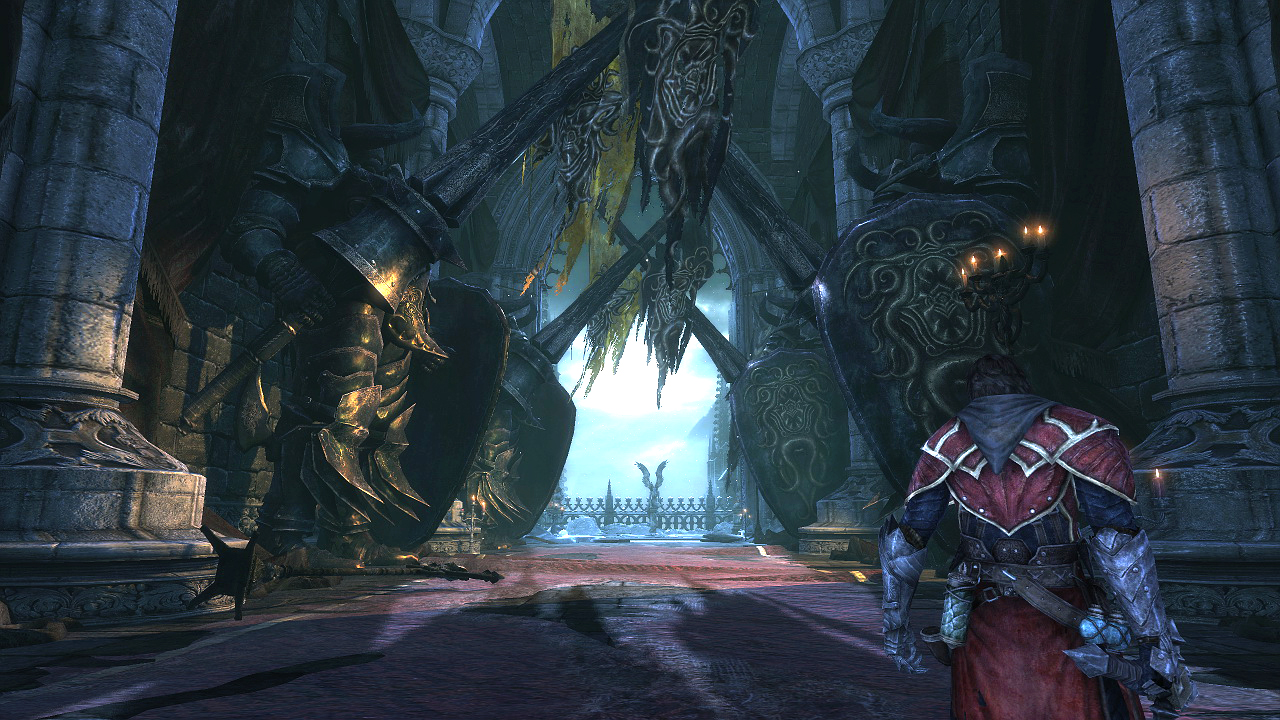
One of the biggest selling points for Castlevania games has always been their gothic backdrops and attention to detail. I’m glad to say that Lords of Shadow delivers on this front. The visuals are nothing short of stellar, and they only get better as the game progresses. The early stages see a lot of lush, detail-packed environments full of color and motion. These stages are impressive, but not exactly what Castlevania followers might expect. Later in the game, though, the environmental designs really shine. Gabriel will climb up shambling gothic towers, get lost in decaying garden mazes, walk through caves illuminated solely by candlelight, wander through ornate and gilded halls of once-bustling castles, and even visit a desolate realm where enormous titans have found their final resting place. Even in the most dreary and isolated locales, Lords of Shadow displays an absolutely stunning amount of detail.
Fortunately, the same dedication was shown to the universe they’ve created. Each and every enemy has their own entry the in-game bestiary. Many of the enemies have backstories as to how they came into creation, while others explain some of the roots of the monsters based on the fiction or mythology they’ve originated from. Players also stumble upon fallen Knights of the Brotherhood of Light, many of which have scrolls recording their discoveries. Some of these scrolls provide solutions to the more complicated puzzles, some indicate specific enemy weaknesses, and yet others detail nothing but the individual’s perilous journey down a path to inevitable death.
The major parts of Castlevania: Lords of Shadow are broken up into chapters, twelve in total, with each chapter containing anywhere from one to eight stages. The entire layout is reminiscent of 16-bit era action/platformers, albeit with a slight twist. Players can go back and explore any of the previously-conquered segments at any time simply by going into the overworld map. This becomes a necessity later in the game, as the hero will come across different relics that will allow him to access previously-restricted areas. In one of the earliest stages, the player comes across a Brotherhood Ark, or a glowing blue treasure chest, that clearly contains something desirable. Of course, it can’t be reached at that particular moment because Gabriel’s abilities haven’t yet progressed to the point where he can access it. Backtracking isn’t too much of a chore considering the payoff, however, seeing as how as both unseen Brotherhood Arks and fallen soldiers with health and magic upgrades are abundant.
Lords of Shadow does pack a few surprises. Aside from numerous puzzles, the protagonist is tasked with taking down massive Titans. As had been touted, these bouts show heavy influences from Shadow of the Colossus. Gabriel also finds himself caught up in a couple of puzzles I dare to call minigames. At one point, players compete against a vampire in a war game very much less chess, and another instance find themselves playing a variant of plinko in order to open a gate.
I must comment on Lords of Shadow’s phenomenal audio. The narration by Patrick Stewart sets a great mood (if not just a bit too over-the-top at times), and the voice work for Gabriel and the Lords themselves leave nothing to be desired. The music is also perfectly matched for the tone of the game. Composer Óscar Araujo reportedly commanded a 120-piece orchestra and a choir 80 persons strong, and the talent involved really shows. The orchestral music is top notch, both in how suitable it is for the various scenes as well as the quality in which it was recorded. If anything negative could be said about it, it’d be that it can be just a bit too intense. The soundtrack also features a few modern renditions of classic Castlevania tunes, which were an absolute joy to experience.
The only real downside to the game is the camera. All too often, the camera will whip around in a way that is downright disorienting. Since most of the levels are linear, moving backwards along a path gives the player essentially no room to see what is right in front of them. In other instances, enemies will be readying themselves for attack just off-screen. While this is the most annoying problem, there is a remedy – the player can turn on enemy health bars which can be seen through obstacles and from considerable distances. The downside to this approach, of course, is losing a bit of the sense of immersion that the developers worked so hard to instill.
Castlevania: Lords of Shadow really shows the evolution of video games, especially in comparison to earlier Castlevania games. It isn’t exactly what fans of the series expect, nor is it what fans of action/adventure games are used to. It manages to blend old-school sensibilities while taking modern-era action games to a new level. It might not be the best action game available, and it may not be the best Castlevania game to date, but Lords of Shadow is easily one of the most impressive games of this generation.
| Castlevania: Lords of Shadow |
|
| Playstation 3, Xbox 360 | |
 |
Publisher: Konami |
|
Doin’ It RIGHT: - Tense, enjoyable combat. - Stunning visuals and audio work. - Well-realized, cohesive, and interesting world. |
Doin’ It RONG: - Very challenging. - Camera can go from annoying to debilitating. |
|
FINAL SCORE: 9 / 10
|
|


Discussion
Make sure to have a Gravatar linked to your email to have a unique avatar next to your name!
No responses to "Review: Castlevania: Lords of Shadow"
There are no comments yet, add one below.
Leave a Comment